
Kitchens and grease traps
BionRio
A fat-breakdown microbial powder for grease traps that lets beneficial bacteria eat the grease
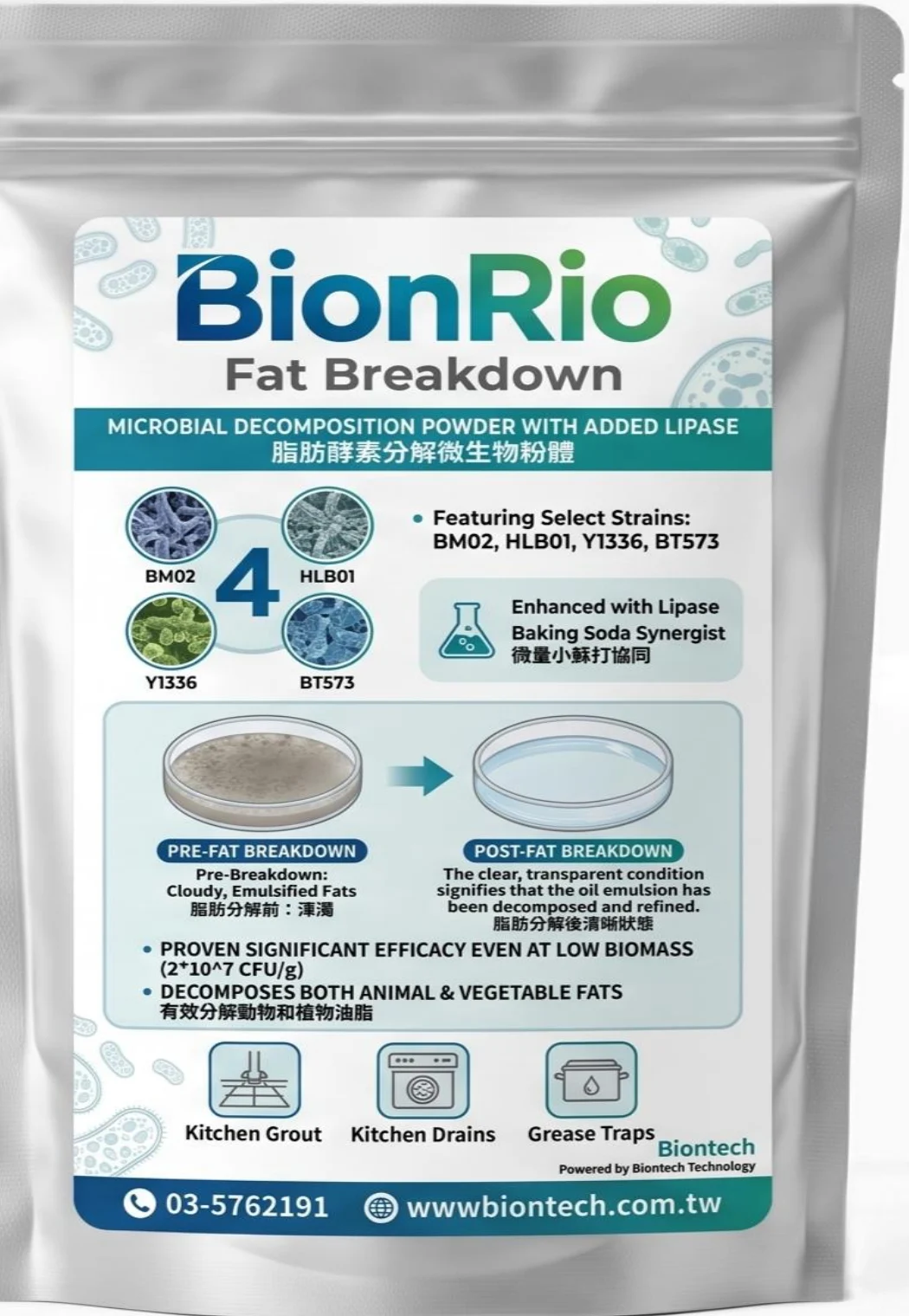
Grease traps catch the fat and food solids in kitchen wastewater so drains do not block, but the grease that collects there smells, sets hard and needs frequent manual cleaning. BionRio is built on four selected Bacillus strains, with added lipase and a little baking soda working alongside them. The bacteria grow on the grease in the trap and keep producing fat-digesting enzymes, breaking the grease down, reducing odour and cutting how often the trap needs cleaning by hand.
- Four selected strains: Y1336, BT574, HLB01, BM02
- Breaks down both animal and vegetable fats
- Added lipase, with a little baking soda working alongside
Specifications
- Format
- Powder
- Strains
- Bacillus Y1336, BT574, HLB01, BM02
- Added
- Lipase, a little baking soda
- Scoop
- About 20 g per scoop
- Where
- Grease traps, kitchen drains, kitchen tile grout
WHY TRAPS CLOG
Why does a grease trap need cleaning so often?
A grease trap holds back the fat and food solids in kitchen wastewater so the drains do not block. But the grease is only held, not removed: the layer floating on the water grows thicker, sets hard as it cools and starts to smell, until someone has to scoop it out by hand.
BionRio lets beneficial bacteria break that grease down inside the trap, so less of it builds up and the trap needs cleaning by hand less often.
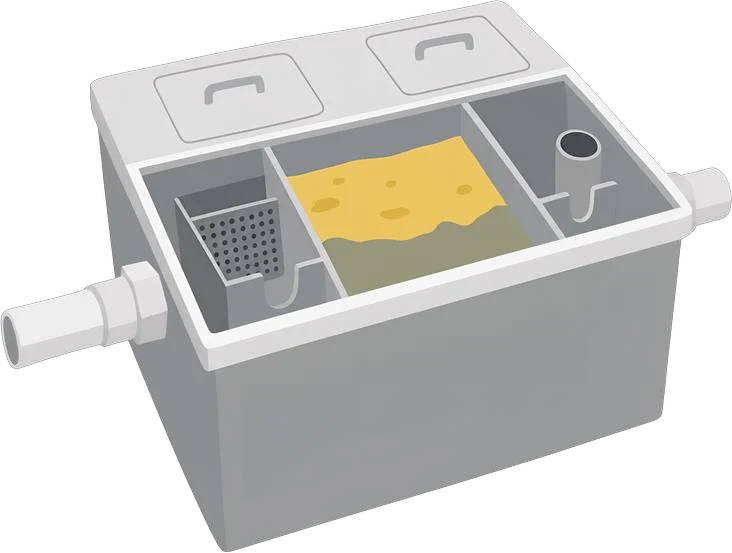
A grease trap: kitchen wastewater passes a strainer that catches the solids, and the grease floats to the surface and builds up
HOW IT WORKS
How the bacteria eat grease
The bacteria find the grease in the trap and attach to it, secrete lipase that splits it into fatty acids and glycerol, take those up as energy and nutrients, and finally convert them into carbon dioxide, water and biomass. The grease layer stops building up and the trap stays cleaner.
- Grease builds up in the trap
- The bacteria find the grease, move in and attach
- They secrete enzymes that break the grease down
- The grease splits into fatty acids and glycerol
- The bacteria take these up as nutrients
- They convert them into carbon dioxide, water and biomass
- The grease is gone and the trap is cleaner
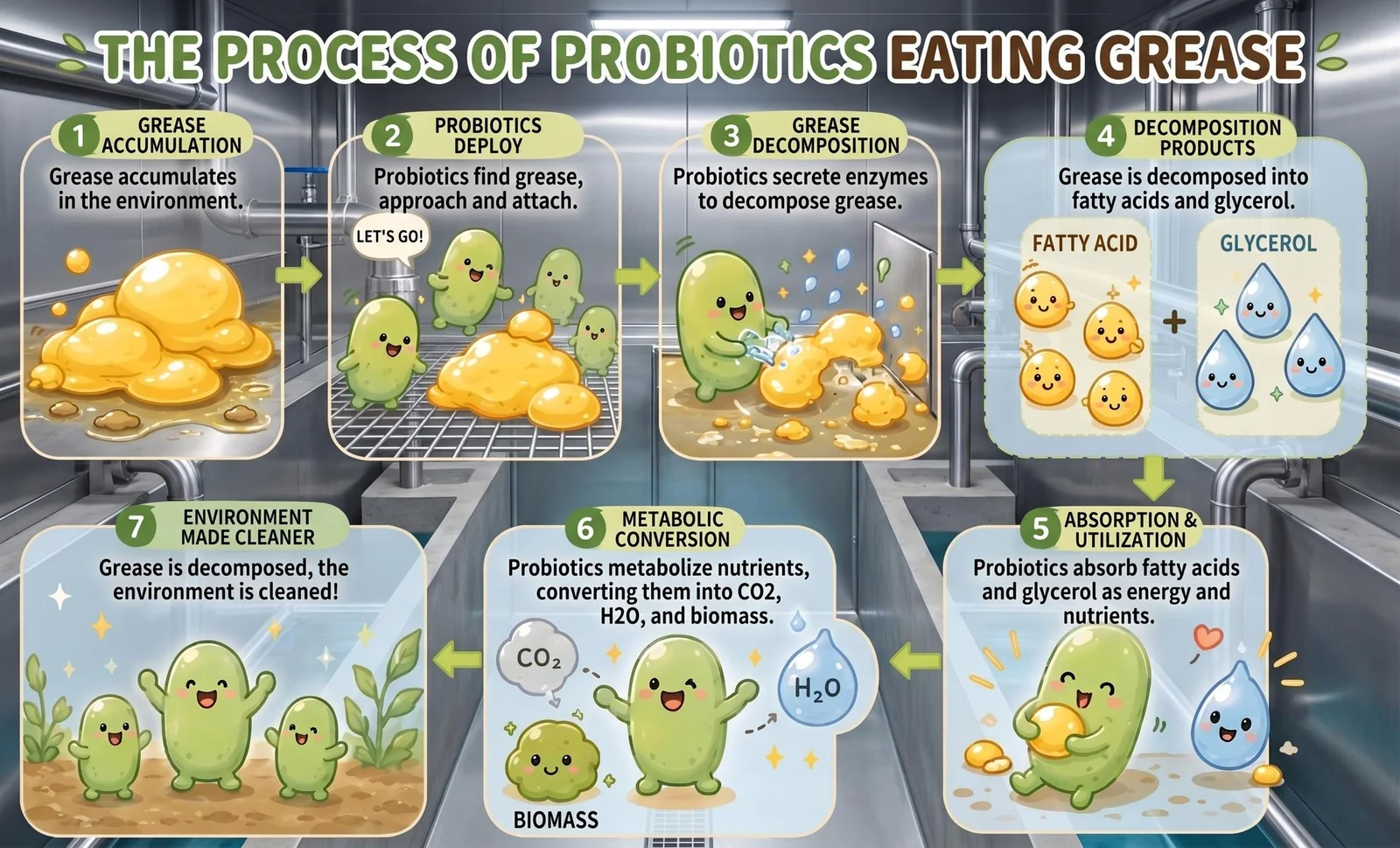
The seven steps of bacteria breaking down grease
FAT BREAKDOWN TEST
Screening twelve strains for fat breakdown
Biontech prepared growth media containing 1% lard (animal fat) or 1% palm oil (vegetable fat), with 0.2% Tween 80 to disperse the fat evenly, then cultured twelve of its own strains at a low 2 × 10⁷ cells per gram for 72 hours to compare how well each broke the fat down.
A medium that turns from milky to clear shows the emulsified fat has been broken down. Even at this low count, BM02, HLB01, Y1336 and BT573 performed well on both fats. Biontech then compared single strains and a combination on real grease-trap fat (see the next section), and settled on Y1336, BT574, HLB01 and BM02 as the four strains in BionRio.
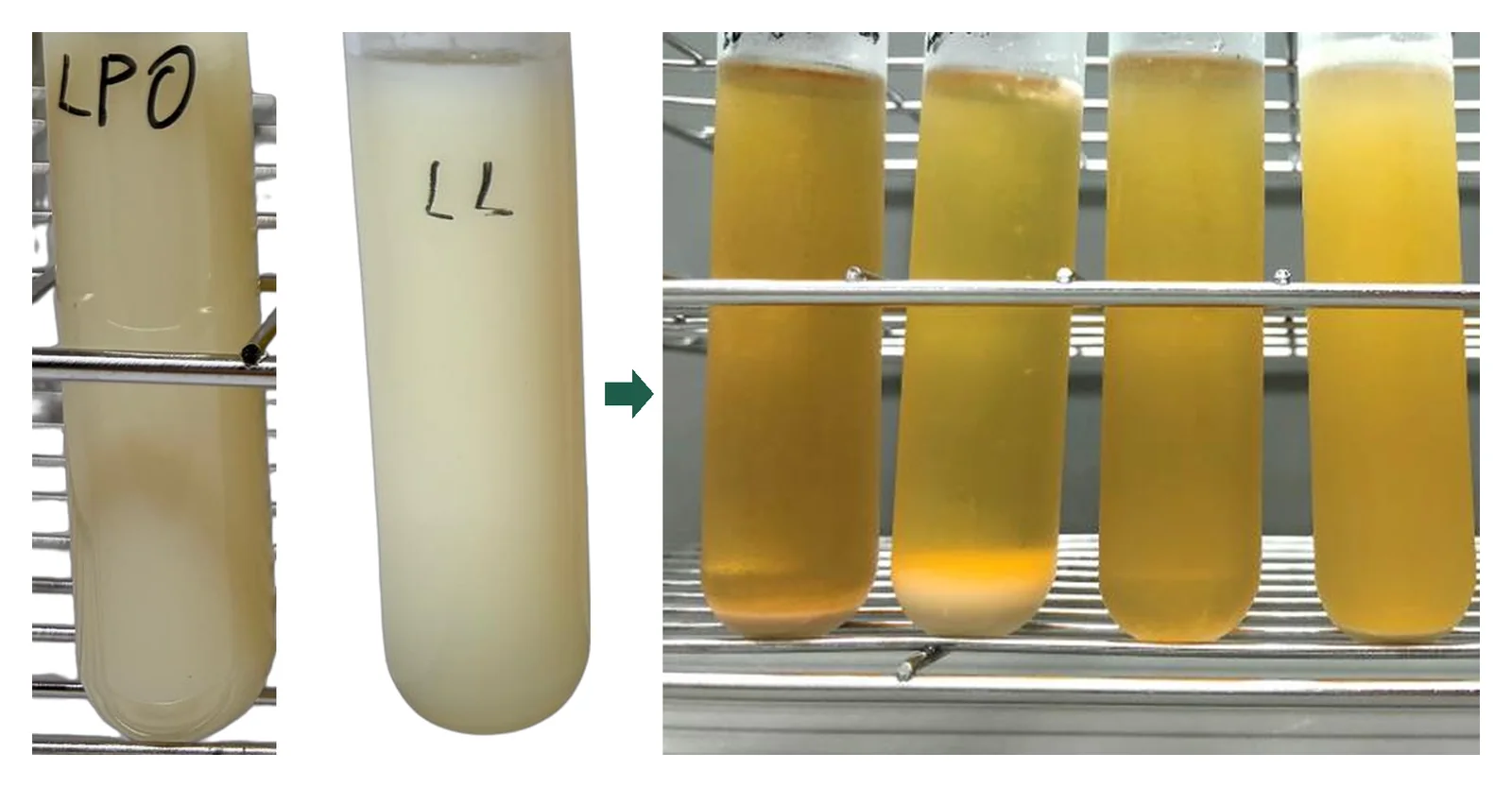
Left: palm oil (LPO) and lard (LL) media before breakdown, milky and cloudy. Right: clear after 72 hours; the sediment at the bottom is the bacteria 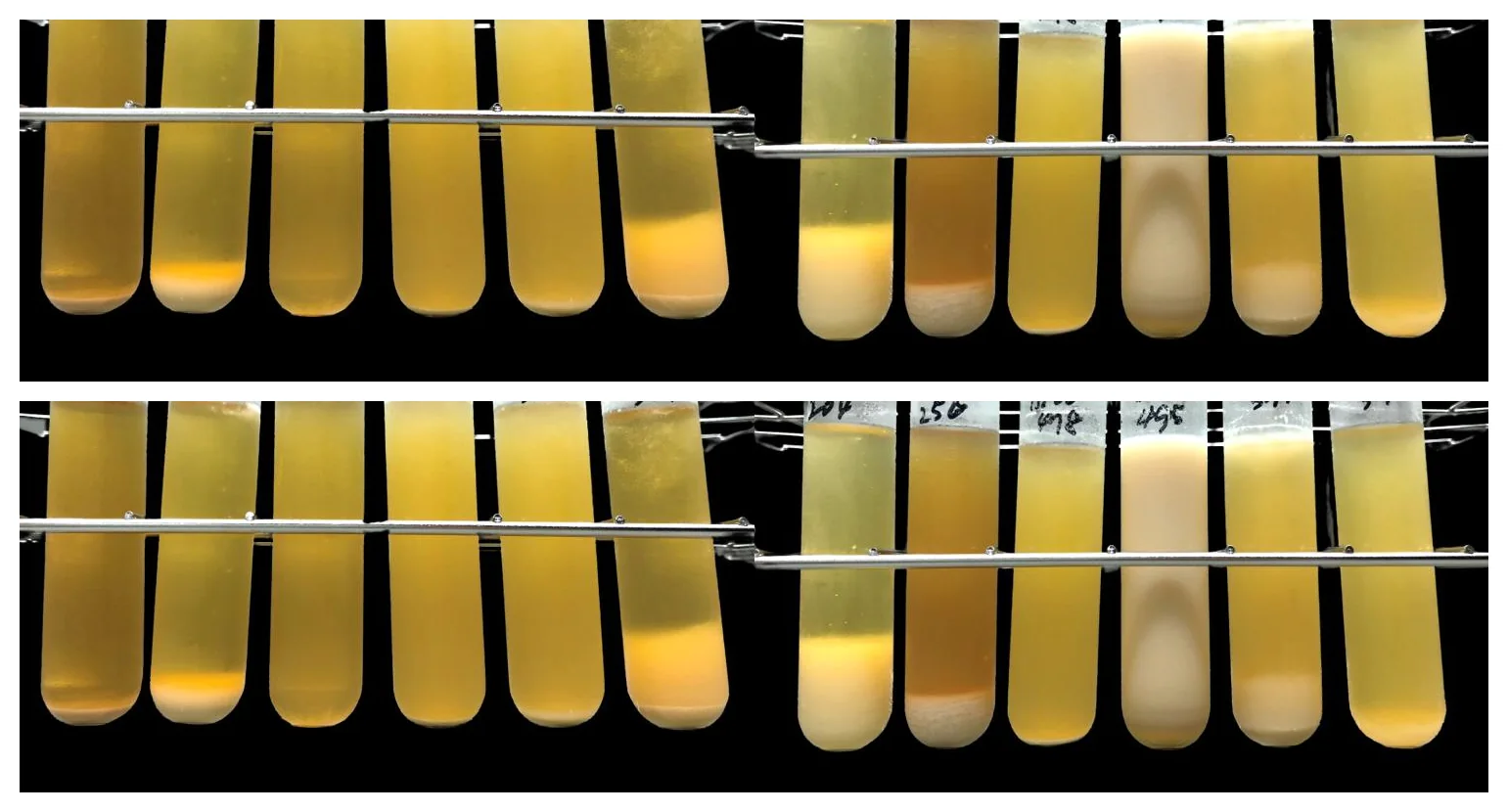
Twelve strains screened, palm oil on the top row and lard below; left to right BM02, BN02, HLB01, Y1336, BT573, BT574, BT204, BT256, BT478, BT495, BT571, BT572
GREASE TRAP TRIAL
A simulated grease trap: 62% of the fat broken down in 7 days
To stay close to real use, Biontech ran a simulation with lumps of grease taken from a food factory's grease trap. Each tube held 5 g of fat plus either BionRio's four-strain consortium (Y1336, BT574, HLB01, BM02), a single strain, an enzyme-only liquid or plain water, and was kept at room temperature for 7 days; each bacterial treatment received 5 × 10⁹ cells.
From day 3 the grease in the consortium tube was visibly emulsified. On day 7 the tubes were centrifuged and the undigested fat in the sediment was weighed: the consortium left only 1.9 g, breaking down 62%, while the enzyme-only liquid, with no live bacteria, left 3.8 g, or 24%. Live bacteria keep growing on the grease and secreting enzymes, so they break down far more of it.
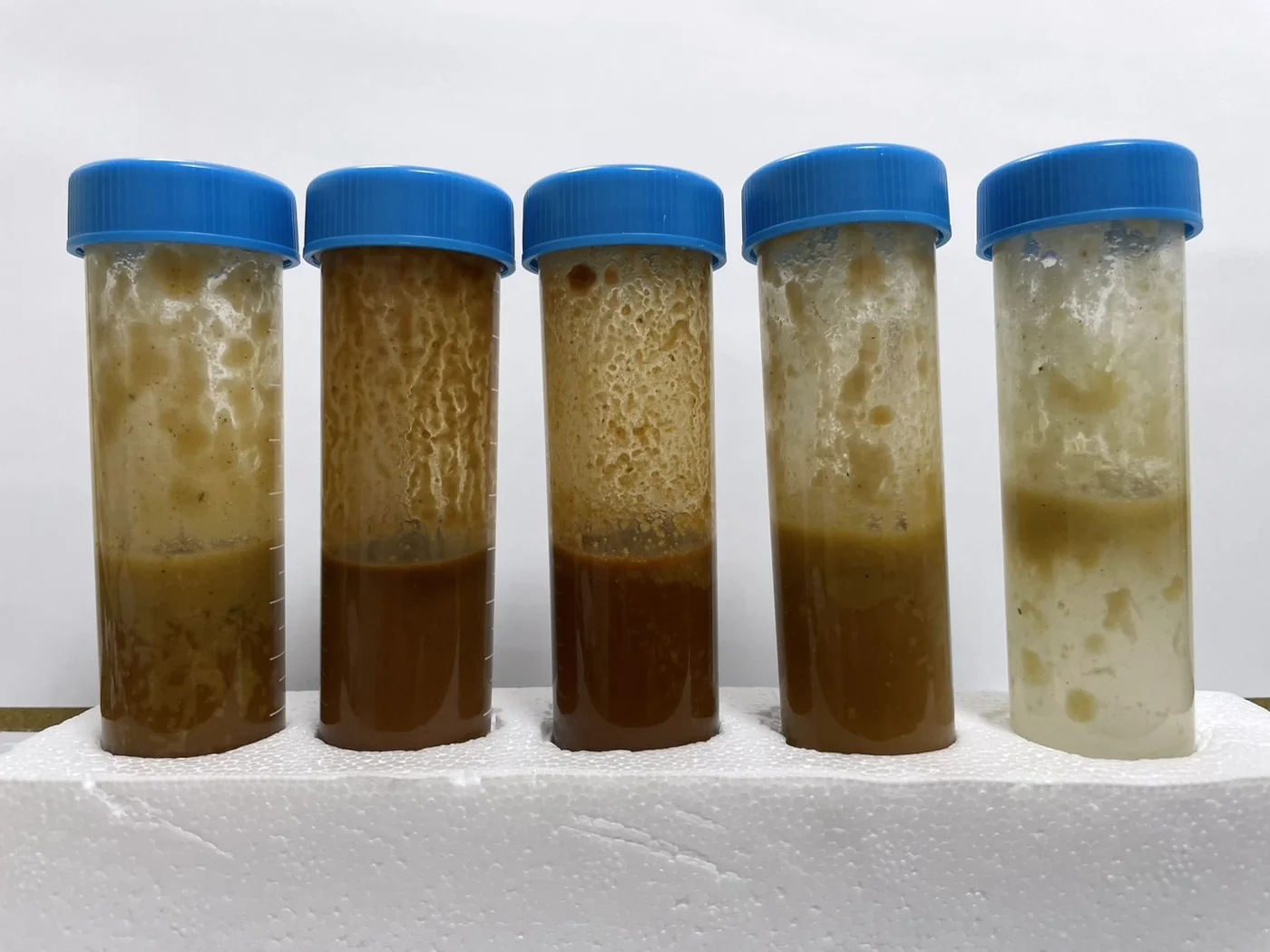
Day 3, left to right: BT573, consortium, BT574, Y1336, water. The grease in the consortium and BT574 tubes is visibly emulsified 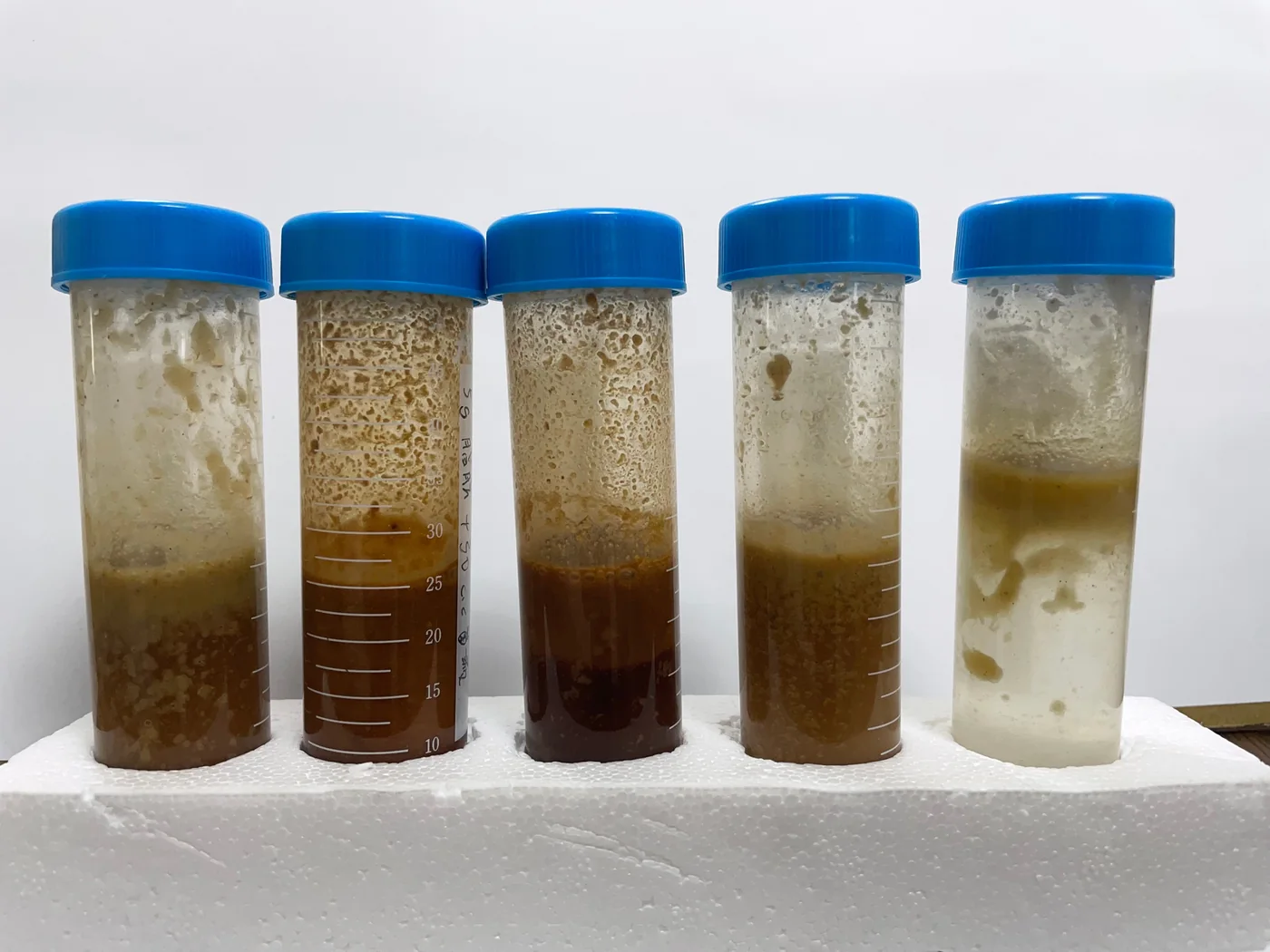
Day 7, same order: the consortium keeps breaking the grease down and emulsifying it, while the water tube still holds white lumps of fat
Directions (powder)
- Use the scoop provided to pour the powder straight into the grease trap and stir lightly, or mix it 1:10 with water first.
- Add it at the end of each business day, once the kitchen has stopped draining, so the bacteria can establish in the trap. It can also be poured into drains for routine care.
| Use | Start-up (first two weeks) | Maintenance |
|---|---|---|
| Home kitchen drain | Twice a week, 1 scoop (20 g) each time | 1 scoop (20 g) a week |
| Small to medium grease trapUp to about 500 litres | 40–60 g a day | 60–80 g a week |
| Large grease trap or central kitchenOver 500 litres | Scale up with capacity, adding one small-to-medium dose for every further 500 litres; our sales team can help you assess | |
Dilute with room-temperature water, never above 50°C. Strong acids, alkalis, bleach and disinfectants kill the bacteria; use a neutral cleaner instead.
Where to use it
- Grease traps in restaurants and central kitchens
- Routine care of kitchen drains
- Grease in kitchen tile grout