
Bacillus subtilis Y1336 | Biological control of soilborne diseases
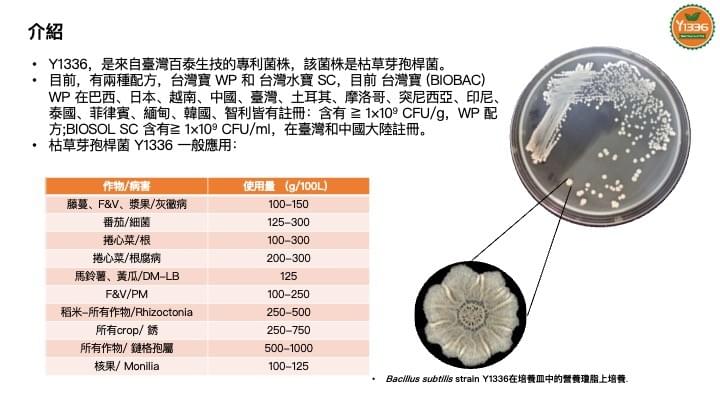
Biontech introduces Bacillus subtilis Y1336 and its role in the biological control of soilborne diseases.
- BIOBAC WP

FIELD PRACTICE
Original images, research records and searchable text help explain the relationships between crops, strains and field applications.
2 RECORDS
Original images are preserved alongside searchable transcriptions. If the text differs from an image, the original image takes precedence.
Biontech introduces Bacillus subtilis Y1336 and its role in the biological control of soilborne diseases.

Field research on EMPOWER biofertilizer application and transplanted rice production.
FROM FACEBOOK
Posts first shared on our Facebook page. Each summary below is in English; the original posts are in Chinese.
A tomato greenhouse trial by Tunisia's IRESA regional research centre for horticulture and organic agriculture, published in the Brazilian Journal of Microbiology in January 2026, used BIOBAC® (Bacillus subtilis Y1336) as the commercial biofungicide reference. Compared with the untreated control, it reduced wilt incidence by 63.1% and stem vascular browning by 74.1%, and gave the highest root fresh weight of the trial (31.80 g against 20.17 g). Source: Aydi Ben Abdallah R. et al. (2026). Braz J Microbiol 57:32. doi:10.1007/s42770-025-01843-2.
Original post on Facebook (in Chinese)
View on FacebookRoot-knot nematodes burrow into crop roots, form galls and block nutrient uptake, often with no visible sign above ground. Y1336 (Bacillus subtilis) was tested in a GEP-standard field trial conducted by Eurofins Agroscience Services in Spain. In the tomato greenhouse trial, Y1336 raised marketable fruit yield by +29.9%, better than or on par with the commercial standard reference product.
Original post on Facebook (in Chinese)
View on FacebookY1336 forms biofilm quickly to colonise the rhizosphere, produces lipopeptides (surfactin, iturin, fengycin) and enzymes (chitinase, β-1,3-glucanase) that act against fungal pathogens, and induces systemic resistance (ISR) in the crop. In a balloon flower stem and root rot trial, Biobac 50WP as a pre-planting soil treatment gave 60.84% control after 8 months; applied at 0.1% twice, 7 days apart, after symptoms appeared, it gave 50.84% at 2 weeks and 60.00% at 4 weeks. The post also sets out an IPM programme rotating Y1336 with fosetyl-Al.
Original post on Facebook (in Chinese)
View on Facebook